Web cookies (also called HTTP cookies, browser cookies, or simply cookies) are small pieces of data that websites store on your device (computer, phone, etc.) through your web browser. They are used to remember information about you and your interactions with the site.
Purpose of Cookies:
Session Management:
Keeping you logged in
Remembering items in a shopping cart
Saving language or theme preferences
Personalization:
Tailoring content or ads based on your previous activity
Tracking & Analytics:
Monitoring browsing behavior for analytics or marketing purposes
Types of Cookies:
Session Cookies:
Temporary; deleted when you close your browser
Used for things like keeping you logged in during a single session
Persistent Cookies:
Stored on your device until they expire or are manually deleted
Used for remembering login credentials, settings, etc.
First-Party Cookies:
Set by the website you're visiting directly
Third-Party Cookies:
Set by other domains (usually advertisers) embedded in the website
Commonly used for tracking across multiple sites
Authentication cookies are a special type of web cookie used to identify and verify a user after they log in to a website or web application.
What They Do:
Once you log in to a site, the server creates an authentication cookie and sends it to your browser. This cookie:
Proves to the website that you're logged in
Prevents you from having to log in again on every page you visit
Can persist across sessions if you select "Remember me"
What's Inside an Authentication Cookie?
Typically, it contains:
A unique session ID (not your actual password)
Optional metadata (e.g., expiration time, security flags)
Analytics cookies are cookies used to collect data about how visitors interact with a website. Their primary purpose is to help website owners understand and improve user experience by analyzing things like:
How users navigate the site
Which pages are most/least visited
How long users stay on each page
What device, browser, or location the user is from
What They Track:
Some examples of data analytics cookies may collect:
Page views and time spent on pages
Click paths (how users move from page to page)
Bounce rate (users who leave without interacting)
User demographics (location, language, device)
Referring websites (how users arrived at the site)
Here’s how you can disable cookies in common browsers:
1. Google Chrome
Open Chrome and click the three vertical dots in the top-right corner.
Go to Settings > Privacy and security > Cookies and other site data.
Choose your preferred option:
Block all cookies (not recommended, can break most websites).
Block third-party cookies (can block ads and tracking cookies).
2. Mozilla Firefox
Open Firefox and click the three horizontal lines in the top-right corner.
Go to Settings > Privacy & Security.
Under the Enhanced Tracking Protection section, choose Strict to block most cookies or Custom to manually choose which cookies to block.
3. Safari
Open Safari and click Safari in the top-left corner of the screen.
Go to Preferences > Privacy.
Check Block all cookies to stop all cookies, or select options to block third-party cookies.
4. Microsoft Edge
Open Edge and click the three horizontal dots in the top-right corner.
Go to Settings > Privacy, search, and services > Cookies and site permissions.
Select your cookie settings from there, including blocking all cookies or blocking third-party cookies.
5. On Mobile (iOS/Android)
For Safari on iOS: Go to Settings > Safari > Privacy & Security > Block All Cookies.
For Chrome on Android: Open the app, tap the three dots, go to Settings > Privacy and security > Cookies.
Be Aware:
Disabling cookies can make your online experience more difficult. Some websites may not load properly, or you may be logged out frequently. Also, certain features may not work as expected.
“Why do I need research? I don’t need to write an Honors Thesis.” “I can’t do research; I’m not a STEM major.”
“Why should I do research? I’m not going to medical school.”
Do any of these statements sound familiar? Have you said or thought these yourself? If you’re asking yourself these questions or if you’re skeptical about getting involved in research, read on.
Close your eyes and picture a “researcher.” The image that probably popped into your head was a person in a white lab coat sitting at a lab bench, working with a pipette and a microscope. That person is a researcher, but they represent only a fraction of what research looks like.
Before coming to UConn, I didn’t know what research could look like. I was stuck on the image of the person in the white lab coat. However, as I became more involved with research, I realized it didn’t have to look like that. As an undergraduate researcher working on an IDEA Grant project investigating the relationship between participation in free/reduced school meal programs and sense of belonging at school, I collect quantitative survey data and qualitative interview data. I spend a lot of time at my computer reading previously published research papers, creating surveys, and statistically analyzing data. The type of researcher I am is another tiny fraction of what it looks like to be engaged in research.
For an English major, research could involve reviewing literature archives and writing a literature review summarizing what they read and how it can contribute to a more extensive investigation. The SHARE Summer Apprenticeship program supports social sciences, humanities, and arts students. This program is geared towards first- and second-year students from underrepresented backgrounds with little to no research experience. In addition, research does not only involve analyzing data or literature. Research can also include creative and community service projects. The IDEA Grant program supports various creative projects, from documentaries to composing music to puppetry. Engaging in research will look different for everyone! Continue reading →
Almost a year and a half ago, I was nearing the end of my sophomore year at UConn. As an Electrical Engineering major, I was getting my first look at upper division course work, finally starting to peel back the curtain on what people in my field do on a daily basis. I’ll be honest; it terrified me.
I, like most people, don’t like the feeling of not understanding something. Worse still is the feeling of not even being able to describe your lack of understanding, because that would require you to understand any number of other complicated things to put your ignorance in context. It’s a feeling rife with anxiety, and it is this uneasy feeling that washed over me as I continued to work through my courses in the Spring of 2022. Had I made the wrong choice of major? Was this just not in the cards for me? Was I to blame, was it some failure on my part, some personal defect? Maybe I just wasn’t cut out for this…
I knew these questions were normal to an extent, especially at the halfway mark of my undergraduate journey. But that did little to allay my fears, and another question began to burn into my mind; What can I do to make this feeling go away?
Eventually, I was convinced by people close to me to investigate the possibility of getting involved in research. Several of my friends had great experiences with research, and they thought I could get something positive out of it. At first, I was very hesitant. “Who would want to take me on as a researcher?”, I remember thinking to myself. “I don’t know anything. I’m barely keeping up with my classes and I have no confidence in my knowledge or experience.” Despite these misgivings, after a brief search process and some exploratory meetings with faculty, I managed to land a summer job as an undergraduate research assistant at the UConn Eversource Energy Center. Continue reading →
Another fall semester at UConn. Undoubtedly, it’s been a whirlwind of moving in, seeing new faces (or re-acquainting yourself with familiar ones), and settling into the rhythm of classes. By now, you’re most likely aware that many of your professors and TAs are involved in research in addition to just teaching. Whether they’re using their research to introduce themselves to the class, weaving references to it in between lecture slides, or complaining about deadlines (professors are human too!), they’ve probably made that fact abundantly clear. Without a doubt, research is an integral part of the work being done at this university. But what does this actually mean for you?
Most students’ first exposure to research is in college, so there’s naturally a lot of confusion and apprehension about it. Maybe you’re in awe of all the cool research being done at the university and you’re itching to work on your own project, but you don’t know how you can find a mentor or if you even can do research as an undergraduate. More likely, your eyes are glazing over as you wonder if you could ever get to that level of knowledge in your subject—research seems like an interesting way to get there, but it just seems so hard to get started. If those scenarios describe you at all, then you’ve come to the right place. In this blog post, we’ll be trying to dispel some common myths about research and help you understand what it’s like to be involved in research (Hint: you can do it and it can be really great!).
I’m just an undergraduate student. Are we even allowed to do research?
Yes! Many professors are happy to take in undergraduates who show a strong interest in their work. We even have an entire office at UConn (OUR!) dedicated to providing support and resources to undergraduates who want to get involved in research. Generally, there’s a really great culture surrounding undergraduate research here at UConn, and we’re always excited to have more students share in that!Continue reading →
As a STEM major, my biggest misconception about research was that I would spend more time at the lab bench than at my desk. I was surprised to find that for the first week of my time with the Health Research Program, I ran one or two experiments and then spent the rest of my time reading papers. At first, I felt like I wasn’t doing enough work since I wasn’t getting any data, but as I began to design my own experiments and brainstorm project directions, I realized just how important it is to learn from others’ projects. Reading research articles has been a constant throughout my time involved in undergraduate research, and through experience, I’ve discovered a few tricks that I would have loved to know when I was just getting started. While these tips are based on my experience in STEM research, hopefully one or two of these tips can help you as you begin your research journey, no matter the field!
1) Write down every paper you read
I don’t know how many times I’ve thought to myself, “oh I read this in a paper,” and then realized I couldn’t remember which paper I found it in. Especially when I was first getting started, I read a lot of research papers to get introduced to the field, but thought about them in almost the same way as a textbook for a course where once I learned the material, I could move on. I didn’t realize how much I would need to refer back to papers later on, especially the materials and methods section for guidance on how to plan my own experiments.
Whether it’s a hand-written list kept in your lab notebook or typed out on your computer, write down the title and a few key points or relevant experimental techniques from each paper you read. I’m usually someone who prefers to handwrite rather than type (and did when I first started making my list), but for ease of reference, I’d recommend a typed list. Control/Command+F will be your best friend once you’ve read enough articles, and having the direct links available is extremely helpful. Continue reading →
The journey through the world of research is as unpredictable as it is exciting. There is never one clear cut way to find your passion through research, and often this requires a bit of trial and error. On some occasions, someone’s first research mentor fits their every need, and that is great! However, that’s not the case for everyone, and sometimes it’s better to expand your horizons. There are a variety of reasons someone may want to diverge from their original research mentor. Whether it’s for convenience, disagreements, or just the passion to pursue something new, it’s OK to feel like you fit better somewhere else. But leaving your lab or mentor can be a daunting task. What if they react poorly? What if I lose a connection? Am I really making the right decision?
It is completely understandable for these thoughts to be rushing through your head, this is a big decision, and these conversations are never easy to have. But there are a few things that are crucial to know about breaking up with your mentor:
1) Do not feel guilty for leaving
When deciding to leave a lab, it can be easy to put it on yourself. Imposter syndrome is common for early-career researchers. Was I not smart enough for the lab? Am I just not made for research? What if I hurt their research by leaving? It’s normal to have second thoughts when you decide to leave. However, you should not feel guilty about your exit. You have every right to explore all the wonderful areas of research on campus, and you are not confined to one single research group for the entirety of your career. If a research group makes you feel guilty about exploring other options on campus, that is a glaring indicator of a toxic workplace that does not treat its students with respect. Continue reading →
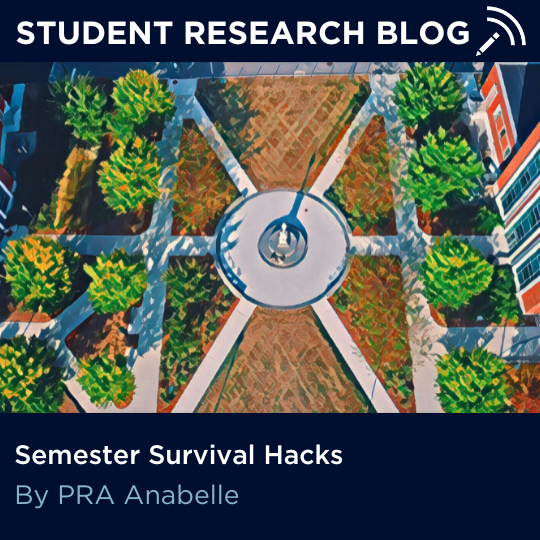
Navigating research, academics, and extracurriculars can be daunting. Luckily, time management doesn’t need to be scary! At the beginning of every semester, I take some time to reflect on my study and schedule habits. That way, I am in tune with what works for me and what doesn’t. Every semester offers new experiences that change how I approach my responsibilities. I thought I would share some advice on what makes me successful, though it is important to note that just because these tips work for me, doesn’t mean they will work for you. Here are my top five study and schedule hacks to help you succeed this semester.
Dedicated blocks of time– This tip helped me during one of my toughest semesters. Just like you would put a class or club into your schedule, put a block of time that is dedicated for studying. Do not schedule anything else during these times. This will allow your mind to become used to dedicated time to focus. Also, it will assist you in becoming more disciplined with your study habits.
Disconnect – Turn off your phone and computer notifications. You may have heard this a million times, but I promise it makes a difference. Staying focused and present during your study time is a valuable skill to have. Having a distraction free environment will also help prepare you for exams.
Take breaks – Remember to take a few moments when you are studying, and throughout the day, to ground yourself. Take a few deep breaths or drink water. It can even be helpful to set a timer for when to take a break while you are studying. As I mentioned, staying focused is key but remember that you are human. Studying for 4 hours straight can do more harm than good, so setting few minutes of time to go for a walk or grab a snack is beneficial.
Surround yourself with people who understand – Part of surviving the semester is knowing when to throttle up and when to throttle down. You won’t be able to go to every girls night, party, or sporting event. Surrounding yourself with people who understand that you may need some nights to catch up on work or self-care will help immensely. Having a strong support system is key to surviving the semester.
Listen to your body and mind – If you do not get anything else out of this blog post, at least take this piece of advice. Listen to yourself. You know yourself better than anyone. So, if you are feeling overwhelmed, allow yourself to set back and reset. This might look like a hike, a walk around town, or a long gym session. There is nothing more important, even academics, than making sure you are healthy and happy.
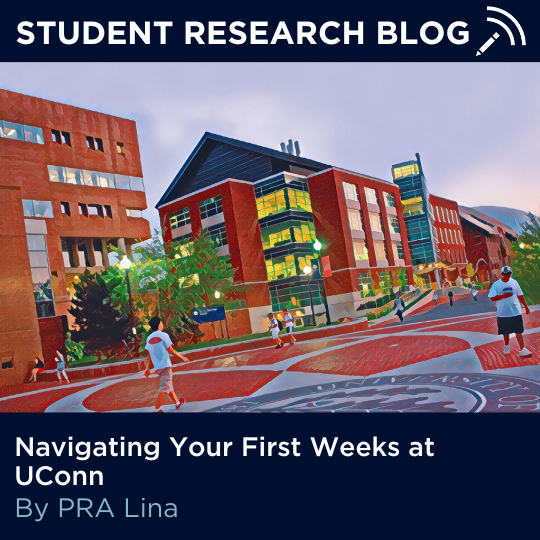
As thousands of new students are welcomed to UConn, the excitement is palpable on campus. With each new student comes the beginning of a new journey, and though this transition can be fantastic, it is also a time when many students are facing new challenges and anxieties. I can say from personal experience, your first few weeks at UConn will probably be a little chaotic, but within this chaos you will find new passions and overcome new challenges. I want to share some tips that can make your transition less stressful!
1) Settle In
At this point you’re probably just discovering UConn’s seemingly endless resources. Maybe you’ve left the Involvement Fair with a list of ten clubs you want to join, or you just opened Blackboard and have no idea how to post a discussion board. It may seem like everything is moving at lightning speed and information is being thrown at you from all sides.
If you’re anything like I was, you might be feeling stressed about making the most out of every minute. My best advice at this point is to slow down and take a breath. I promise none of the clubs or activities or dining hall “specials” are going anywhere. What’s most important now is acclimating yourself. Regardless of if you’ve lived away from home before, being a part of the UConn community is a major lifestyle change. Try and find the things that work for you and establish a routine. I remember my first semester on campus, I felt like I was being pulled into activities left and right. It took me a long time to feel settled and I think I caused myself unnecessary stress trying to do everything at once. Taking some time to settle into a routine gives you a chance to take small steps towards making new friends, learning new study habits, and discovering activities. Freshman year is about exploration. It’s about taking your time and figuring out what works for you and what you want out of UConn. Calming yourself down and settling in is the first step to having a great first year! Continue reading →
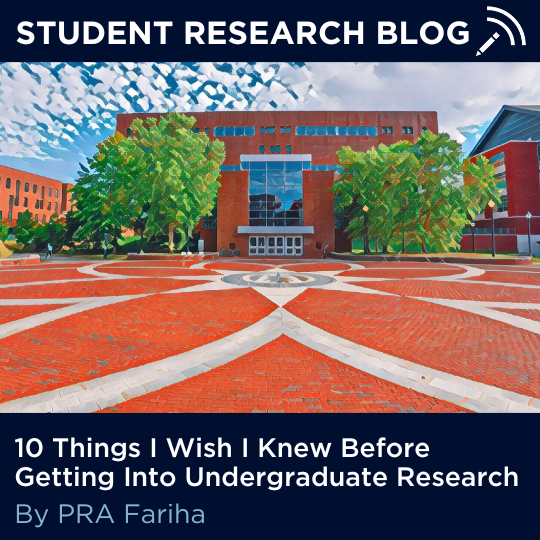
Being involved with research is an invaluable opportunity that I think everyone should take advantage of during their undergraduate years. I can definitely say that being involved in undergraduate research has been transformative for me academically, but also honed my skills and set my career trajectory on a promising path. As I reflect on my own experiences, here are ten insights I wish I had known before embarking on this exciting endeavor (in no particular order):
1) The Power of Inquiry
The old adage “Don’t be afraid to ask questions” holds true, though I’ll admit even I hesitated. It can be very intimidating when you’re surrounded by graduate students and professors who are very clearly extremely knowledgeable and busy. However, overcoming that intimidation and seeking clarification can open up opportunities for deeper understanding and more analytical thinking. Continue reading →
In recognition of the pivotal role that mentors play in supporting undergraduate research and creative activity, the Office of Undergraduate Research is pleased to announce the recipients of the 2023 Mentorship Excellence Awards. These awards recognize two faculty members – one in a STEM field, and one in a non-STEM field – and one graduate student who exemplify the ways in which outstanding mentors challenge and support their students, enabling them to take intellectual risks and achieve milestones they might not have initially envisioned being able to reach.
Please join us in congratulating Na Zhang, Wendy Mok, and Chelsea Garcia on their selection as this year’s Mentorship Excellence Award recipients. The awards were presented on Friday, April 14, 2023 and Tuesday, April 18, 2023 during the Frontiers in Undergraduate Research Poster Exhibitions at Storrs and Stamford.
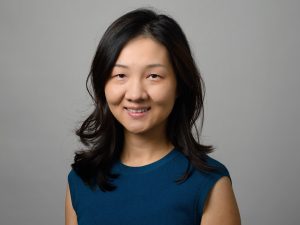
Na Zhang, Assistant Professor, Human Development and Family Sciences
Professor Zhang was nominated by Victoria Almazán ’25 (CLAS) and Abigail Ricketts ’24 (CLAS). The following text is excerpted from their nominations.
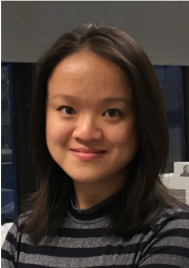
2023 Mentorship Excellence Award winner Na Zhang, Ph.D., Assistant Professor of Human Development and Family Sciences.
When choosing a career path, I was often stuck on what would bring me everything I wanted: a clinical outcome for social good, as well as the opportunity to keep learning, writing, and reading every day. I considered a variety of careers such as social work, medicine, therapy, and more. However, these were all missing a certain component and I did not want to settle. Through learning research skills, I realized that research filled the learning component of my career goal and made it a goal to become more involved. However, I was still stumped on what that meant for me career-wise. I decided to set up a meeting with Dr. Zhang and ask for her thoughts. I described to her in a very dramatic way that I was suffering from a career crisis. She listened to me and asked me what my research interests were and told me about clinical psychology. While I had heard about the career previously, my understanding of it was vague at best. I researched people in the field, graduate programs, and more, and learned that it fit every single component I was looking for. Since describing this career goal to Dr. Zhang, she only increased her level of support. I am extremely grateful to have a mentor like Dr. Zhang help me shape my research interests in the social sciences and broaden my horizons in learning experiences I never expected to have. – Victoria Almazán
It quickly became obvious to me that Dr. Zhang is the type of mentor who genuinely cares about me, my interests, and my success. When developing my research plan she helped me to go above and beyond what I thought I was capable of doing. For example, Dr. Zhang encouraged me to submit an abstract of my preliminary findings to a psychology research conference. Before, I was not very aware of what occurs at these research conferences and how much of a benefit being accepted to present at one would be. With her guidance, I was able to submit an abstract and be accepted to present at the annual Association for Psychological Sciences Convention. This will be extremely beneficial for my professional and research goals because I will be able to see what research is currently being conducted in my field, as well as network with experienced and successful professionals. Dr. Zhang is the reason I will be able to have this opportunity that I didn’t even know was possible for me. – Abigail Ricketts
Wendy Mok, Assistant Professor, Molecular Biology and Biophysics
Professor Mok was nominated by Stephanie Schofield ’23 (CLAS). The following text is excerpted from Stephanie’s nomination.
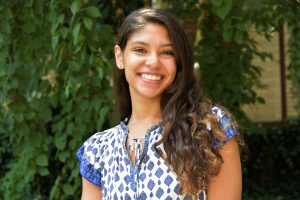
2023 Mentorship Excellence Award winner Wendy Mok, Ph.D., Assistant Professor of Molecular Biology and Biophysics.
Since the day I joined the lab, Wendy has challenged me to grow as both a scientist and as a person. In the first months before I even started working in person with her, she set up weekly meetings to help me digest scientific research papers so that I set a strong foundation for my research. After my very first poster at Fall Frontiers, Wendy challenged me to go further. Together, we worked on submitting abstracts to various conferences across New England. I recall, when I went to the BIG EAST Symposium to present my work, she was so excited that she posted a picture of me in front of my poster, and I was so honored by this. Wendy motivated me to apply for grants and programs, supporting me tirelessly on the applications and also quelling my fear of failure. When I received word that I was not selected for one program, I was devastated. Wendy hugged me and told me, “Do you know how many grants I have applied for in my life?” and when I was unsure, she answered, “Probably 50 by now, and all I needed was one to come through.” Months later, we worked to turn that unsuccessful proposal into a SURF award application that supported my research last summer and made me hungry to keep dreaming bigger. In the fall, I independently applied for a Fulbright grant and recently learned of my selection as a finalist! The foundation I built in Wendy’s lab, both in terms of technical skills and writing skills, made these opportunities possible.
Aside from her mentorship, over the last two years, Wendy has grown to become like a mother to me. While I have been responsible for my own success, Wendy has made my dreams possible through all her love, support, encouragement, and mentorship. I walked into her lab a timid, shy undergraduate, and now walk out with five posters, three projects, two successful grants, and one publication under my belt. Sometimes I get emotional about leaving the lab after graduating this spring. Wendy once gave me a big hug and showed me that she had cut a leaf off of our lab plant in her office. She told me that when anyone graduates from her lab, they get their own piece of the plant as a parting gift. “You’re just beginning, with me you’ve grown so much that now you get a new pot, a new environment. And you’ll grow and thrive there always knowing that we are just one family in your life.”
Chelsea Garcia, Ph.D. Student, Nutritional Sciences
Chelsea was nominated by Paige Dossias ’23 (CAHNR). The following text is excerpted from Paige’s nomination.
2023 Mentorship Excellence Award winner Chelsea Garcia, Ph.D. student in Nutritional Sciences.
Like many new students, I felt intimidated about working in a lab. However, after meeting Chelsea for the first time, my worries were immediately put at ease. She was incredibly welcoming and gave me a thorough tour of the lab we would be working in together. Once I began reading the lab protocols, I admitted I was struggling to understand. Chelsea took the time to reassure me that this was completely normal and that she would explain things on a step-by-step basis, which was a great relief. After the first week, I knew I wanted to be involved in this lab for my remaining time at UConn.
I feel incredibly fortunate to have Chelsea as a mentor. She is someone I know I can always count on for support – not only with my research projects, but also for guidance on opportunities outside the lab. Chelsea creates an open and safe environment where students can go to her for just about anything. She has answered what feels like thousands of questions and has made time to meet with students even when she is busy. Whenever she learns that I am working on a project or a piece of writing, she offers to review and provide constructive feedback. Chelsea makes it clear to everyone in the lab to prioritize their health above all else. It is evident that she has a genuine passion for mentorship and wants us to succeed. She is an excellent role model — from how she teaches students in our lab, to her willingness to support other students and faculty, as well as her hard work and dedication to research and academics.
With Chelsea’s guidance, I have become more independent and able to solve problems on my own. She has shown me her thought-process on how to approach issues when challenges arise in the lab. She emphasizes how mistakes are an important part of the learning process and how we can use them to grow as researchers. She taught me to document every observation, which is something I have incorporated into my everyday life. For every protocol I’ve learned, Chelsea ensures I understand how each experiment and reagents work before moving on. She even goes as far as to share examples of safety hazards she’s witnessed in the past, as well as the most common lab errors and sources of contamination. These examples have been invaluable to me and I’ve been able to pass this learning onto incoming students.
Chelsea continually encourages me to take on new projects and apply for awards, even when I was uncertain. One of the most frequent phrases she says is, “I believe in you.” I am in awe of how much I’ve grown as a student, researcher, and person under her guidance. I never could have imagined how much I would learn through research and how incredibly rewarding and fun it can be. Even with something as simple as blasting Disney music while we work, she is always looking for ways to create an enjoyable and relaxing learning environment. I cannot thank Chelsea enough for her unwavering support and guidance during my time here at UConn. She has had a profound impact on my undergraduate experience, which will serve me for years to come. She has been one of the best mentors I’ve ever had and given me a foundation to build on for my future. For this, I am forever grateful.
Congratulations to the 2023 award recipients! The Office of Undergraduate Research thanks the undergraduate students who nominated their faculty and graduate student mentors as well as the Peer Research Ambassadors who served on this year’s selection committee.
Sometimes it may feel like there aren’t enough hours in the day for all we have scheduled for ourselves: classes, clubs, self-care, assignments, work, meals, and more! With days where an overwhelming lineup of activities are on your schedule, research may feel like another stressful activity in a long list of ‘to-dos.’
Throughout my time at UConn, there are a few different strategies I’ve found helpful for those days where chaos seems to outweigh balance, and which have helped me with time and stress management. Compiled below are my top four pieces of advice on juggling research amidst a busy schedule, so that not only will you be able to enjoy the research process more by having a greater mental bandwidth for it, but also it will help alleviate current and future stress!Continue reading →
URL:https://events.uconn.edu/live/json/v2/events/response_fields/location,summary/date_format/%25F%20%25j,%20%25Y/group/Office of Undergraduate Research/max/4/
If not explictly stated otherwise, start_date/today and end_date/6 months are implied in the URL.
 “Why do I need research? I don’t need to write an Honors Thesis.”