Navigating the Summer Research Experience: Part 3

By: Marisa Boch, OUR Peer Research Ambassador

The Research Experience

It may be your first time doing full-time research, and 8 hours of lab each day may seem daunting at first. The best way to ease those nerves is to know what to expect…

Typically, you will be assigned to a PI and will be working most closely with a graduate student on a specific project. You may begin the first week or two conducting literature review in order to plan the study (experimental aims, experimental methods, methods of analysis, etc.) while also learning basic laboratory techniques/procedures. In my experience, once my graduate student and I finished putting together the formal study outline, I then presented the outline to my PI to get feedback. These first few weeks may be more deskwork than laboratory work, but becoming proficient at conducting literature searches and learning how to plan out all aspects of a study are valuable skills! Continue reading

Navigating the Summer Research Experience: Part 2

By: Marisa Boch, OUR Peer Research Ambassador

Preparing Your Application

Some programs have different formats, but as a general rule of thumb your application will include a personal statement, letters of recommendation (2), an official transcript, and (occasionally) a resume:

1) Personal Statement: The program instructions for a personal statement will probably resemble something along the lines of: Describe in ### words your educational and professional goals and how your participation in the XYZ Program will assist in meeting your goals. Be sure to articulate your qualifications and your reasons for wishing to participate in this program (Adapted from Harvard Summer Research Program in Kidney Medicine Application 2018). Start your personal statement early on.

Continue reading

Navigating the Summer Research Experience: Part 1

By: Marisa Boch, OUR Peer Research Ambassador

REU, SURF, SURE, STAR, SMART, STaRS. Summer research programs are typically an assortment of acronyms with letters representing some combination of the words “summer” and “undergraduate” and “research,” along with the classification of the program (“experience,” “internship,” “fellowship,” “program”). No matter the name, each of these different programs represents a window of opportunities for aspiring undergraduate researchers. A summer research internship can be a way to begin your research endeavors, providing you with an avenue to continue research during the academic year. It can be a way to fully immerse yourself into full-time research, learning more and gaining more experience than may be possible when conducting research during the school year. Perhaps most importantly, it can provide insight into what role research may play in your future and whether a research career is for you.

Summer research experiences can be invaluable, but navigating the application process and starting off as a full-time student researcher can be daunting. In this 3-part blog, I talk about my tips for applying for summer research programs, from where to find opportunities to writing your personal statement, as well as what to expect from (and how to get the most out of) your research experience.

Continue reading

• Congratulations, Fall 2017 UConn IDEA Grant Recipients!

Congratulations to the nineteen UConn undergraduates who have been awarded UConn IDEA Grants in the fall 2017 funding cycle! Thirteen of the award recipients will be completing individual projects, and six will be working on collaborative group projects.

The award recipients represent a variety of disciplines, from nursing to puppetry, biomedical engineering to ecology and evolutionary biology. They will conduct independent research projects; produce documentaries, novels, and creative nonfiction pieces; design prototypes; and engage in service initiatives.

Click here to view the full list of fall 2017 UConn IDEA Grant award recipients.

Special thanks to the faculty and staff that supported student applications to the UConn IDEA Grant and to those who will be mentoring the award recipients as they complete their projects.

The UConn IDEA Grant program awards funding to support self-designed projects including artistic endeavors, community service initiatives, traditional research projects, entrepreneurial ventures, and other creative and innovative projects. Undergraduates in all majors at all UConn campuses can apply. Applications are accepted twice per year from individuals and from small groups who plan to work collaboratively on a project. The next application deadline is March 12, 2018.

All for Research and Research for All

By: Divya Ganugapati, OUR Peer Research Ambassador
A common myth about undergraduate research is that it is only intended for students interested in pursuing post-graduate programs. While research background may be beneficial for undergraduates looking towards graduate schools, it can also serve as a very influential experience for students seeking employment post-graduation.

In fact, research is a vital part of each profession and is constantly being performed by professionals in all lines of work. Don’t believe me? Here are just a few of many examples of the importance of research in various fields that might not require a graduate degree: Continue reading

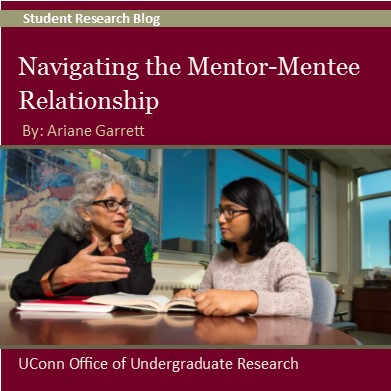
Navigating the Mentor-Mentee Relationship

By: Ariane Garrett, OUR Peer Research Ambassador

The mentor – mentee relationship in a lab can be tricky to navigate. Unmet expectations are often the cause of breakdowns in the relationship. It’s essential to clarify goals and expectations early on to assure a productive and satisfying experience. Remember that the mentor-mentee relationship goes two ways. Just as your mentor holds you to certain baseline standards, you should expect certain things from them as well. As you begin a research experience, use the tips below to help you develop and maintain a strong mentor-mentee relationship. Continue reading

• Congratulations, Summer 2018 UConn Co-op Legacy Fellows!

The Office of Undergraduate Research is delighted to announce the four students selected to receive UConn Co-op Legacy Fellowships to support projects they will complete summer 2018.

Click here to view the full list of Summer 2018 UConn Co-op Legacy Fellowship Recipients.

Born out of the UConn Co-op’s commitment to public engagement, innovative entrepreneurship, social impact, and active mentorship, the UConn Co-op Legacy Fellowship Program provides undergraduates the opportunity to pursue funded summer research projects and/or creative endeavors. Projects pursued through this program represent the legacy of the UConn Co-op’s commitment to public engagement, innovation, and social impact.

Special thanks to the faculty and staff that supported student applications to the UConn Co-op Legacy Fellowship and to those who will be mentoring the award recipients as they complete their projects.

Click here for more information on the UConn Co-op Legacy Fellowship Program.

• Health Research Program – Opportunities for Summer 2018

Trakhtenberg lab
Guided by HRP mentor Dr. Ephraim Trakhtenberg, postdoctoral fellow Juhwan Kim demonstrates microscope-assisted surgery to master’s student Muhammad Sajid (background), HRP student Kathleen Renna, and M.D.-Ph.D. student Bruce Rheaume. (Photo by Ethan Giorgetti)
The Office of Undergraduate Research is pleased to announce the next phase of the Health Research Program (HRP). This program offers a pathway into undergraduate research for students with interests in health and/or the biomedical sciences. By facilitating connections between UConn Health researchers and UConn undergraduates, the program aims to involve more students in research at UConn Health.

For students interested in participating in this program for Summer 2018, here is the key information:

  • Summer 2018 opportunities are now posted on the HRP website. There are 26 opportunities that range from software development to public health, biomaterials to neuroscience, genetics to bioinformatics. The application deadline for these opportunities is Friday, January 26, 2018.
  • All of these opportunities are slated to continue into the 2018-19 academic year. Continuation is contingent on satisfactory progress over the course of the summer and both student and faculty mentor interest in continuing the placement.
  • To be eligible for Summer 2018 HRP opportunities, students must plan to graduate no sooner than May 2019.

Further details and answers to frequently asked questions are available on the Health Research Program website. Students are encouraged to peruse the posted opportunities and begin preparing application materials for any placements of interest. We urge students to take care to consider the time commitment and schedule options involved in a given opportunity to ensure that they can accommodate these demands in their summer and academic year schedule.

• Student Accomplishments – December 2017

accomplishments-heading

Please join us in congratulating the UConn undergraduates named below for their significant research and creative accomplishments in summer and fall 2017. Students: if you have an accomplishment to share, please do so using this online form.

AWARDS

Congratulations to Catherine Cabano ’18 (CAHNR) and Alexander Holmgren ’18 (CLAS), UConn’s two undergraduate representatives at the Universitas 21 Research Conference in Edinburgh, Scotland in June 2017.


PUBLICATIONS

Nicole Gomez ’18 (CLAS) was a co-author on a recent publication from Jessica Rouge’s lab:

Santiana, J. J., Sui, B., Gomez, N., & Rouge, J. L. (2017). Programmable Peptide-Cross-Linked Nucleic Acid Nanocapsules as a Modular Platform for Enzyme Specific Cargo Release. Bioconjugate Chemistry. doi: 10.1021/acs.bioconjchem.7b00629

Naseem Sardashti ’18 (ENG), an undergraduate in the Health Research Program, was a co-author on a recent publication based on research conducted with Dr. Sangamesh Kumbar at UConn Health:

Manoukian, O. S., Arul, M. R., Sardashti, N., Stedman, T., James, R., Rudraiah, S., & Kumbar, S. G. (2017). Biodegradable polymeric injectable implants for long-term delivery of contraceptive drugs. Journal of Applied Polymer Science, 135, 46068. doi: 10.1002/app.46068

Zachary Stempel ’18 (CLAS), a member of William Bailey’s lab, was the second author on two recent publications in Organic Letters and The Journal of Organic Chemistry:

Lambert, K. M., Stempel, Z. D., Wiberg, K. B., & Bailey, W. F. (2017). Experimental Demonstration of a Sizeable Nonclassical CH···G Hydrogen Bond in Cyclohexane Derivatives: Stabilization of an Axial Cyano Group. Organic Letters, 19(23), 6408-6411. doi: 10.1021/acs.orglett.7b03287

Lambert, K. M., Stempel, Z. D., Kiendzior, S. M., Bartelson, A. L., & Bailey, W. F. (2017). Enhancement of the Oxidizing Power of an Oxoammonium Salt by Electronic Modification of a Distal Group. The Journal of Organic Chemistry, 82(21), 11440-11446. doi: 10.1021/acs.joc.7b01965


SUMMER RESEARCH ACTIVITIES

Pierre Fils ’18 (ENG) conducted research at Oak Ridge National Laboratory in the Climate Change Science Institute. Pierre had the opportunity to work on mid-scale, high performance computing clusters to analyze climate data with the goal of redesigning the ASHRAE Climate Zones.

Chelsea Garcia
Chelsea Garcia ’20 (CAHNR)

Chelsea Garcia ’20 (CAHNR) participated in the Bridging the Gap Program funded by the USDA and coordinated by the Department of Nutritional Sciences. Dr. Christopher Blesso served as Chelsea’s research mentor for the summer experience. She presented her research poster, “Effects of Grape Consumption on Postprandial Response to a High Saturated Fat Test Meal,” at the Summer Research Poster Symposium in August.

Mark Garcia ’20 (CLAS) completed a research internship in Dr. Peter Raymond’s Biogeochemistry Laboratory at the Yale School of Forestry & Environmental Studies.

Djion A. Holness ’19 (CAHNR) spent her summer at the University of Georgia engaged in research through an NSF funded REU program. Djion conducted veterinary diagnostic research exploring patters of co-infection in domestic dogs along the Panama Canal.

Two students spent the summer engaged in research at The Scripps Research Institute in Jupiter, FL. Through an NSF funded REU program, Mirella Fernandez ’19 (CLAS) worked in the Page Laboratory studying the effects of a double mutant gene on three known phenotypes of Autism Spectrum Disorder. Sarah Robbins ’18 (CAHNR, CLAS) conducted her summmer research in immunology under the direction of Dr. Matthew Pipkin. Sarah worked with in vivo models and RNAi silencing systems to identify transcription factors that function in CD8+ T cell development.

Tanya Miller
Tanya Miller ’20 (CLAS)

Tanya Miller ’20 (CLAS) participated in the Health Disparities Clinical Summer Research Fellowship Program through the UConn Health Department of Health Career Opportunity Programs (HCOP). Over the course of the seven week program, Tanya worked with the North Central Regional Mental Health Board under the direction of Quyen Truong, Outreach and Evaluation Manager, to research young adults’ opinions on health care. She presented her research “Community Conversation Among Young Adults on Health Care” at UConn Health in July.

Andrea Naranajo-Soledad ’19 (ENG) enjoyed the opportunity to work at Shanghai Jiao Tong University (SJTU), a research-based university in China. Andrea studied photocatalytic, antifouling and humic acid removal properties of a membrane used for ultrafiltration in water.

Brittany Nelson ’19 (ENG) conducted research through the NSF REU program at the University of Wisconsin-Madison and the University of Puerto Rico-Mayaguez. Brittany’s project focused on controlling the behavior of human mesenchymal stem cells (hMSCs).

Kesan Samuel ’20 (CLAS) conducted field research at El Yunque Forest in Puerto Rico. Under the supervision of Dr. Steven Presley, Kesan studied gastropod and phasmid populations, assisting with sampling plots to identify and count various species.

Maya Schlesinger ’18 (CAHNR) completed a summer research fellowship at the San Diego Zoo Institute for Conservation Research. Maya studied a newly discovered parvovirus affecting Red Pandas at the San Diego Zoo. 

Anthonia Wray ’19 (CLAS), an NSF REU recipient, worked under the guidance of Dr. Jessica Plavicki in the Department of Pathology and Laboratory Medicine at Brown University. Anthonia studied the effects of AHR activation in the liver using zebrafish models.


PRESENTATIONS

David Bachoy
David Bachoy ’19 (CLAS)

Society for the Study of Human Development Biennial Meeting – October 6-8, 2017 – Providence, RI

David Bachoy ’19 (CLAS) – OUR Travel Award recipient
Associations Between Marijuana Use and Time Spent Playing Different Types of Video Games Alone and with Others

Biomedical Engineering Society (BMES) Annual Meeting – October 11-14, 2017 – Phoenix, AZ

Norah Cowley ’18 (ENG) – OUR Travel Award recipient
Analysis of Growth and Stiffness of Cancer Spheroids Using 3D-Printed Microtweezer Device

Norah Cowley
Norah Cowley ’18 (ENG)
Amisha Dave
Amisha Dave ’18 (ENG)

Amisha Dave ’18 (ENG) – OUR Travel Award recipient
mHealth Smartphone Application to Measure Risky Driving Behavior and Predict Crashes

Clinton Global Initiative University Conference (CGI U) – October 13-15, 2017 – Boston, MA 

Akshayaa Chittibabu ’19 (CLAS) – Selected as a student presenter

American Physical Society Division of Nuclear Physics Fall Meeting – October 25-28, 2017 – Pittsburgh, PA

Sam Markelon ’20 (CLAS) – OUR Travel Award recipient
gemcWeb

Institute of Chemical Engineers (AIChE) Annual Meeting – October 27-30, 2017 – Minneapolis, MN 

Katherine Saltzgiver
Katherine Saltzgiver ’18 (ENG)

Katherine Saltzgiver ’18 (ENG) – OUR Travel Award recipient
Production and Utilization of Biochar from the Slow Pyrolysis of Food Waste

Obesity Week 2017 – October 29-November 2, 2017 – Washington, DC

Christiana Field ’17 (CLAS) – OUR Travel Award recipient
Advances in Self-monitoring of Blood Glucose in Type-2 Diabetes: A Study on Patient Experiences

IEEE MIT Undergraduate Research Technology Conference – November 3-5, 2017 – Cambridge, MA

Xinkang Chen ’18 (ENG) &  Md Tanvirul Islam ’19 (ENG) – OUR Travel Award recipients
Comparison of Chirped and Unchirped Superlattices as Adjustable-Strain Platforms for Metamorphic InGaAs/GaAs Devices

Northeastern Glenn Symposium on Biology of Aging – November 9, 2017 – UConn Health, Farmington, CT

Jacob Macro ’19 (CLAS) & Pooja Patel ’18 (CLAS) – Health Research Program participants
Indy Reduction Maintains Fly Health and Homeostasis

Society for Neuroscience (SFN) Annual Meeting – November 11-15, 2017 – Washington, DC 

Danni Dong ’18 (CLAS) – OUR Travel Award recipient
Observational Learning: Comparing a Foraging and Aversive Motivated Task in Female Rats

Thomas Pietruszewski ’19 (CLAS) – OUR Travel Award recipient
Influence of the Social Environment on Female Rats Exploring a Novel Open Field

ASCB/EMBO 2017 Meeting – December 2-6, 2017 – Philadelphia, PA 

Alyssa Mathiowetz ’18 (CLAS) – OUR Travel Award recipient
Actin Nucleation Factors that Control Autophagy are Important for Zebrafish Organ Development

Xinkang Chen and Md Islam
Xinkang Chen ’18 (ENG) and Md Islam ’19 (ENG)
Pooja Patel and Jacob Macro
Pooja Patel ’18 (CLAS) and Jacob Macro ’19 (CLAS)
Danni Dong
Danni Dong ’18 (CLAS)

• Congratulations, 2018 SHARE Award Recipients!

We are delighted to announce the 13 student-faculty teams selected to receive awards for Spring 2018 and thank the University of Connecticut Humanities Institute for its generous support of two of these student awards. Congratulations to all award recipients!

SHARE Awards support undergraduate research apprenticeships in the social sciences, humanities, and arts, offering students majoring in these fields opportunities to develop inquiry skills and explore research interests early in their college careers.


Project Title: The Impact of an Outsider President on Candidate Emergence in Congressional Elections
Student Apprentice: Kyle Adams, Political Science
Faculty Mentor: Paul Herrnson, Political Science

Project Title: Justice in the Dark: How Secretively Funded Campaign Advertisements Shape Judicial Campaigns
Student Apprentice: Erin Dennehy, Political Science
Faculty Mentor: Virginia Hettinger, Political Science

Project Title: Interpersonal Coordination of Goal Directed Actions
Student Apprentice: John Farrar, Cognitive Science
Faculty Mentor: Adam Sheya, Psychological Sciences

UCHI LogoProject Title: The Scholio Project: Designing Online News Comments to Promote Intellectual Humility in Public Discourse
Student Apprentice: Brendan Hogan, Political Science & Psychological Sciences
Faculty Mentor: Michael Morrell, Political Science
Award Co-Sponsored by the University of Connecticut Humanities Institute

UCHI LogoProject Title: Diverse Experiences of and Evaluations about Sexting and Sexting Victimization
Student Apprentice: Emily Mendoza, Human Development and Family Studies
Faculty Mentor: Alaina Brenick, Human Development and Family Studies
Award Co-Sponsored by the University of Connecticut Humanities Institute

Project Title: Executive Approval Analyses in Latin America and Recent Political Developments
Student Apprentice: Shankara Narayanan, Political Science & International Relations
Faculty Mentor: Matthew Singer, Political Science

Project Title: Undergraduate Nursing Students’ Perspectives of Witnessed Simulated Cardiopulmonary Resuscitation and Death in an Opioid Addicted Patient
Student Apprentice: Justin Pedneault, Nursing
Faculty Mentor: Carrie Eaton, Nursing

Project Title: Accountability in Government?:  Assessing the Effectiveness of Ethics Commissions in Connecticut Municipalities
Student Apprentice: Samuel Rostow, Political Science
Faculty Mentor: Kimberly Bergendahl, Political Science

Project Title: A Computer Intervention to Help Reduce Problematic Gambling in College Students
Student Apprentice: Skyler Sklenarik, Psychological Sciences
Faculty Mentor: Robert Astur, Psychological Sciences

Project Title: Social Policy and the Political Lives of American Teenagers
Student Apprentice: Olivia Sykes, Urban and Community Studies & Human Rights
Faculty Mentor: Edith Barrett, Urban and Community Studies

Project Title: Hollow Earth
Student Apprentice: Isabella Uliasz, Studio Art
Faculty Mentor: John O’Donnell, Art and Art History

Project Title: African American Breast Cancer Survivors
Student Apprentice: Caira Ward, Human Development and Family Studies, Africana Studies
Faculty Mentor: Edna Brown, Human Development and Family Studies

Project Title: Psychosocial Factors Influence Pain and Quality of Life in Young Adults with Irritable Bowel Syndrome
Student Apprentice: Tessa Weidig, Nursing
Faculty Mentor: Xiaomei Cong, Nursing