Uncategorized

Lit Review Tips and Tricks

By Emma Beard, Peer Research Ambassador

As a STEM major, my biggest misconception about research was that I would spend more time at the lab bench than at my desk. I was surprised to find that for the first week of my time with the Health Research Program, I ran one or two experiments and then spent the rest of my time reading papers. At first, I felt like I wasn’t doing enough work since I wasn’t getting any data, but as I began to design my own experiments and brainstorm project directions, I realized just how important it is to learn from others’ projects. Reading research articles has been a constant throughout my time involved in undergraduate research, and through experience, I’ve discovered a few tricks that I would have loved to know when I was just getting started. While these tips are based on my experience in STEM research, hopefully one or two of these tips can help you as you begin your research journey, no matter the field!

1)  Write down every paper you read

I don’t know how many times I’ve thought to myself, “oh I read this in a paper,” and then realized I couldn’t remember which paper I found it in. Especially when I was first getting started, I read a lot of research papers to get introduced to the field, but thought about them in almost the same way as a textbook for a course where once I learned the material, I could move on. I didn’t realize how much I would need to refer back to papers later on, especially the materials and methods section for guidance on how to plan my own experiments.

Whether it’s a hand-written list kept in your lab notebook or typed out on your computer, write down the title and a few key points or relevant experimental techniques from each paper you read. I’m usually someone who prefers to handwrite rather than type (and did when I first started making my list), but for ease of reference, I’d recommend a typed list. Control/Command+F will be your best friend once you’ve read enough articles, and having the direct links available is extremely helpful. Continue reading
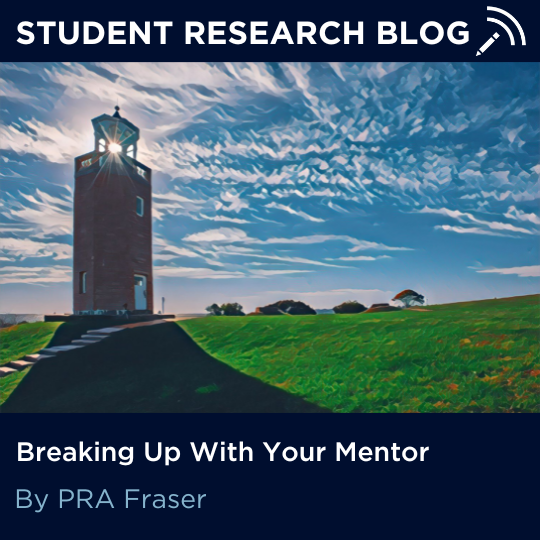
Breaking Up With Your Mentor

By Fraser McGurk, Peer Research Ambassador

Picture of the Avery Point campus lighthouse in a painterly style with text: Student Research Blog, Breaking Up With Your Mentor. By PRA Fraser.What do you do when it’s time to move on?

The journey through the world of research is as unpredictable as it is exciting. There is never one clear cut way to find your passion through research, and often this requires a bit of trial and error. On some occasions, someone’s first research mentor fits their every need, and that is great! However, that’s not the case for everyone, and sometimes it’s better to expand your horizons. There are a variety of reasons someone may want to diverge from their original research mentor. Whether it’s for convenience, disagreements, or just the passion to pursue something new, it’s OK to feel like you fit better somewhere else. But leaving your lab or mentor can be a daunting task. What if they react poorly? What if I lose a connection? Am I really making the right decision?

It is completely understandable for these thoughts to be rushing through your head, this is a big decision, and these conversations are never easy to have. But there are a few things that are crucial to know about breaking up with your mentor:

1) Do not feel guilty for leaving

When deciding to leave a lab, it can be easy to put it on yourself. Imposter syndrome is common for early-career researchers. Was I not smart enough for the lab? Am I just not made for research? What if I hurt their research by leaving? It’s normal to have second thoughts when you decide to leave. However, you should not feel guilty about your exit. You have every right to explore all the wonderful areas of research on campus, and you are not confined to one single research group for the entirety of your career. If a research group makes you feel guilty about exploring other options on campus, that is a glaring indicator of a toxic workplace that does not treat its students with respect. Continue reading

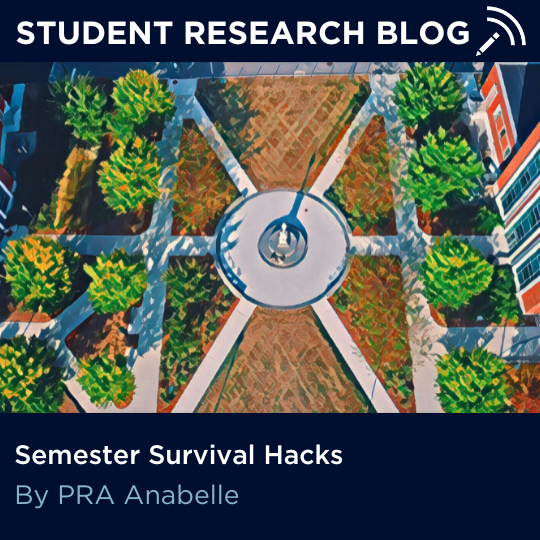
Semester Survival Hacks

By Anabelle Bergstrom, Peer Research Ambassador

Navigating research, academics, and extracurriculars can be daunting. Luckily, time management doesn’t need to be scary! At the beginning of every semester, I take some time to reflect on my study and schedule habits. That way, I am in tune with what works for me and what doesn’t. Every semester offers new experiences that change how I approach my responsibilities. I thought I would share some advice on what makes me successful, though it is important to note that just because these tips work for me, doesn’t mean they will work for you. Here are my top five study and schedule hacks to help you succeed this semester.

  1. Dedicated blocks of time– This tip helped me during one of my toughest semesters. Just like you would put a class or club into your schedule, put a block of time that is dedicated for studying. Do not schedule anything else during these times. This will allow your mind to become used to dedicated time to focus. Also, it will assist you in becoming more disciplined with your study habits.
  2. Disconnect – Turn off your phone and computer notifications. You may have heard this a million times, but I promise it makes a difference. Staying focused and present during your study time is a valuable skill to have. Having a distraction free environment will also help prepare you for exams.
  3. Take breaks – Remember to take a few moments when you are studying, and throughout the day, to ground yourself. Take a few deep breaths or drink water. It can even be helpful to set a timer for when to take a break while you are studying. As I mentioned, staying focused is key but remember that you are human. Studying for 4 hours straight can do more harm than good, so setting few minutes of time to go for a walk or grab a snack is beneficial.
  4. Surround yourself with people who understand – Part of surviving the semester is knowing when to throttle up and when to throttle down. You won’t be able to go to every girls night, party, or sporting event. Surrounding yourself with people who understand that you may need some nights to catch up on work or self-care will help immensely. Having a strong support system is key to surviving the semester.
  5. Listen to your body and mind – If you do not get anything else out of this blog post, at least take this piece of advice. Listen to yourself. You know yourself better than anyone. So, if you are feeling overwhelmed, allow yourself to set back and reset. This might look like a hike, a walk around town, or a long gym session. There is nothing more important, even academics, than making sure you are healthy and happy.

Continue reading

Research: It Shouldn’t Just Be a Box to Check Off

By Ayushi Patel, Peer Research Ambassador

Student Research Blog - Research: It Shouldn't Just Be a Box to Check Off. By PRA Ayushi.As a senior pre-medical student, I have definitely experienced feeling “behind” compared to my peers. We are put into a competitive environment, and it’s only made worse when we realize there’s extremely limited spots for what we are all trying to achieve. This certainly isn’t any better when you feel like other students are “ahead” of you—maybe that means they’re in a research lab already, maybe they have a publication in progress.

Before beginning research, it might seem like the search is overwhelming and getting into a lab is impossible, but this is a process in which you should be selective. There are plenty of steps to follow to help the process. Continue reading

Your Mental Health Is More Important than Your Résumé

Your Mental Health Is More Important than Your Resume. By PRA Stephanie.By Stephanie Schofield, Peer Research Ambassador

One of the most beautiful things about UConn is the endless opportunities that await you. Whether it’s research, the astronomy club, a dance team, a club sport, or perhaps learning a language on your own time, there are a million different ways to fill your time when you’re not in the classroom. With so many avenues for your extracurricular interests, why not indulge in every single one?

Well, unfortunately, there isn’t enough time in the world to do everything your heart desires in college, if only there was! My biggest word of caution: you DO NOT want to learn the art of time-management the hard way! Continue reading

The Importance of Connecting With Your PI

By Alexandra Bettencourt, Peer Research AmbassadorThe Importance of Connecting With Your PI. By PRA Alexandra.

I will never forget my first academic advising appointment as a freshman at UConn, because it was there that I met a mentor who would help to shape the entirety of my academic career. Prior to meeting Dr. Sarah Reed for the first time, I had read her faculty biography to learn more about her. After skimming her qualifications and publications, my eighteen-year-old self, that had just begun taking BIO 1107, was a bit intimidated by her scientific accomplishments. These feelings melted away within minutes of meeting her, as she welcomed me with a smile and genuine enthusiasm for helping guide me through my academic career and accomplish my lifelong dream of becoming a veterinarian. Continue reading

What I’ve Learned Through Involvement in Research

By Kerry Morgan, OUR Peer Research AmbassadorWhat I've Learned Through Involvement in Research. By PRA Kerry.

In my years at UConn, I have been involved in many different types of activities. Whether it be sports, academics, volunteering, hobbies, there is certainly something for everyone at UConn. As I am beginning my senior year at UConn, I look back and reflect on the time I have had here, and most importantly the things I’ve learned and enjoyed. Now, I can say with clarity that research shaped me into the person I am today, and it has been one of my most cherished experiences from my undergraduate education. Continue reading

Setbacks in Your Project? We’ve All Been There

Setbacks in Your Project? We've All Been There. By PRA Maria.By Maria Latta, OUR Peer Research Ambassador

Whether you are working on lab work, human subjects research, an outreach project, or a creative endeavor, you have probably faced at least one setback along the way. I certainly have. Some of the challenges I have faced are: my experiments produced results that didn’t support my hypothesis, my IRB approval was delayed and required revisions, the organizations I partnered with underwent changes that impacted the timeline of my project, and I have just had mental blocks on how to move forward. Continue reading

It Is Okay to Be Told “No”

By Mary Vlamis, Peer Research Ambassador

Trying to get involved in research as an undergraduate student is daunting. It is uncomfortable to enter, or in this case attempt to enter, academia as it is unlike anything you have encountered before. Fortunately, we have the tools to help you with this learning curve to make it as easy as possible. The other source of anxiety most students face is the fear of rejection. No matter how perfectly you construct your first email, or how much you research for your first conversation, there is always the lingering thoughts of, “What if they say ‘No.’” And even worse, “What does that say about me?” The short answer is that it will be okay if you are told no, and that says nothing about you. Continue reading